Our Product
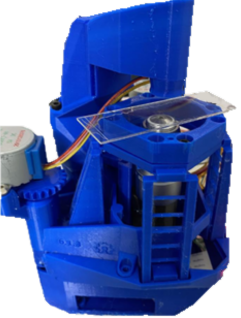
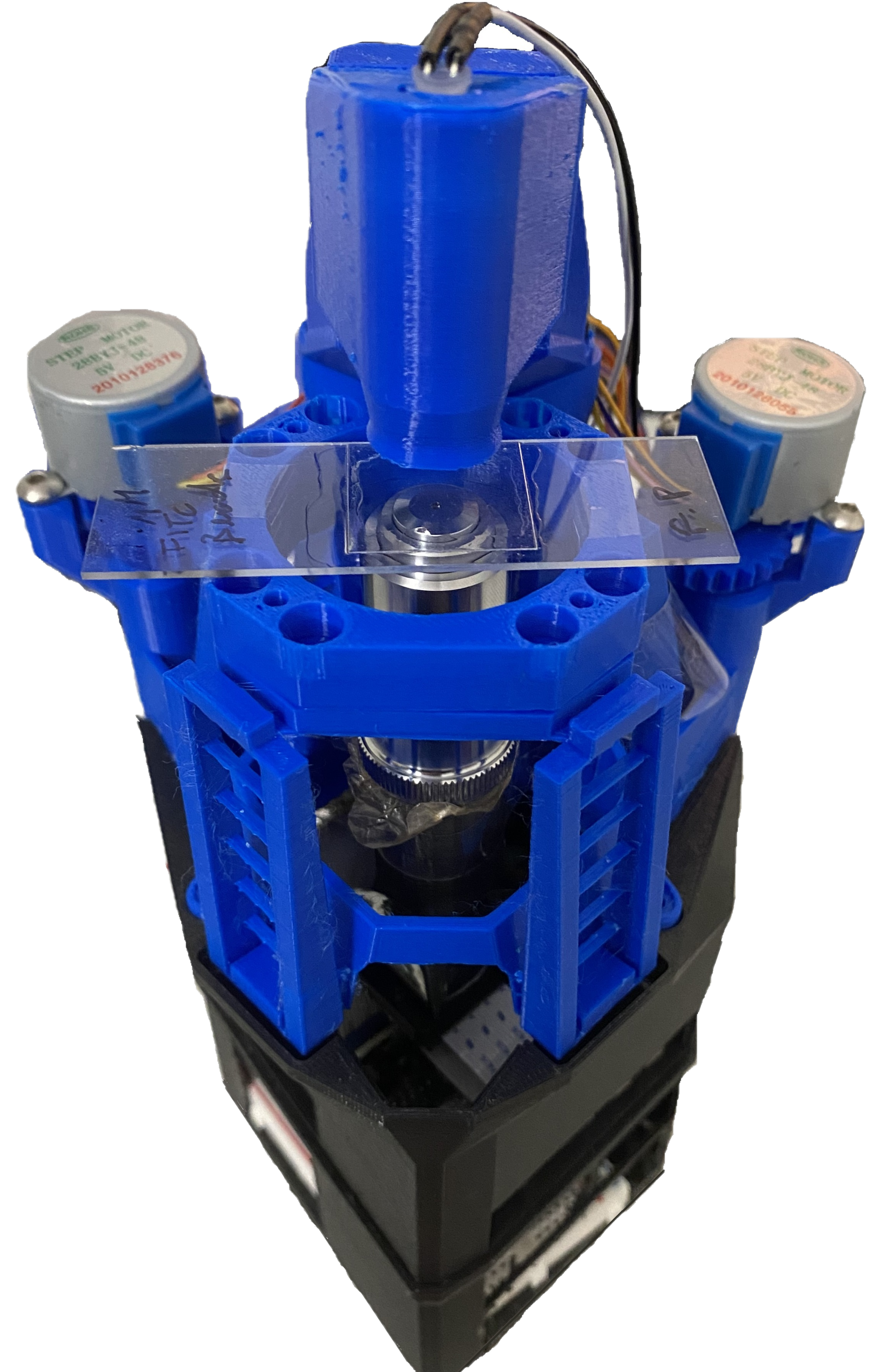
Our microscope will be designed as an integrated, low-cost, portable,
trii-mode (transmission, fluorescence, hyperspectral) light microscope that can be used in all setting,
laboratories, K-12 schools, universities, mobile labs and clinics. We hope this will allow sutdents aand scientists to fulfill their growing research
requirement and interests in the Health and STEM fields.
Design
MicroNAUT is a team of Biomedical and Materials Science engineering students on a mission to
revolutionize the microscope. Our goal is to design an integrated, low-cost 3D-printed OpenFlexure Microscope
(OFM) capable of three imagine modes (transmission, fluorescence, and hyperspectral).
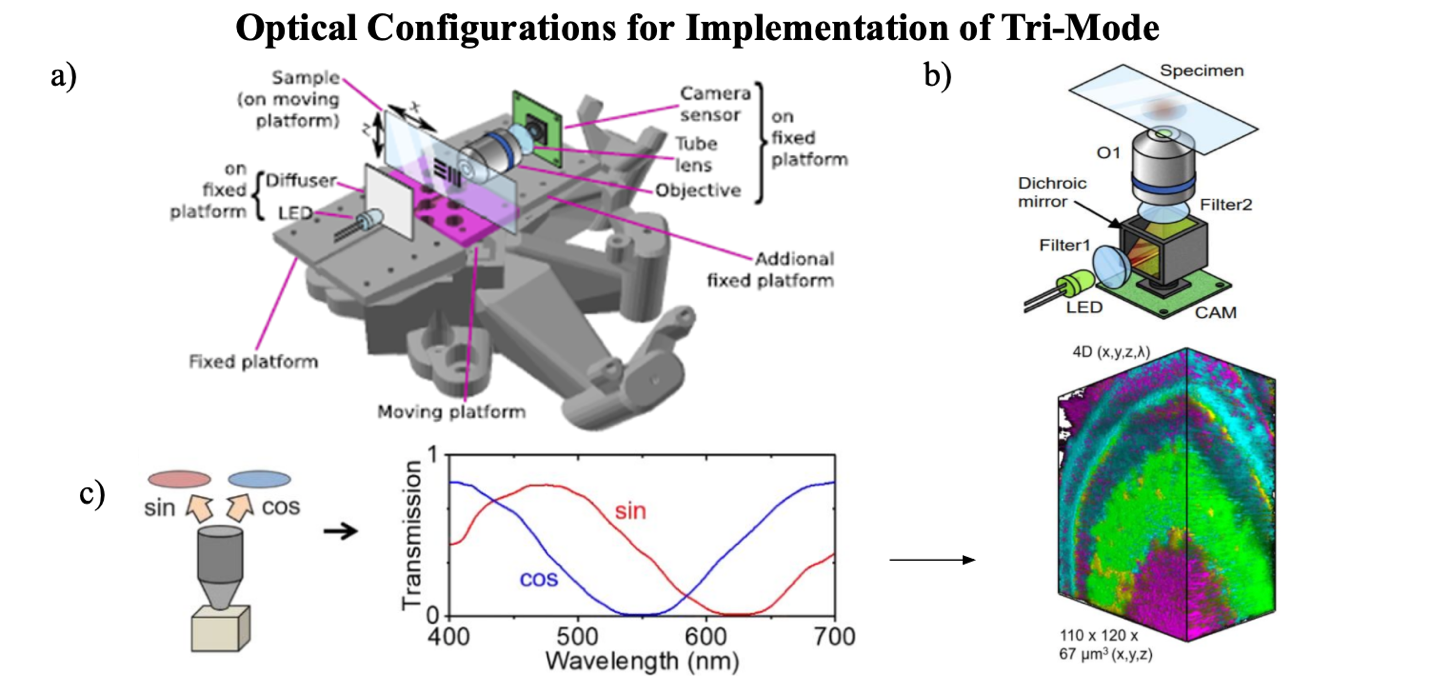
- a) Schematic of OFM via transmission mode. Light diffused through the diffuser will be
transmitted through the specimen on the moving platform via x, y, z direction and magnified by the
objective and tube lens to be captured by the camera sensor
- b) Schematic of OFM via fluorescence configuration. Specimens will be placed on the slide. O1
represents the objective lens used for sample magnification with Filter 1,Filter 2, LED, and Dichroic
mirror as the light filter mechanism. The emitted light will be captured and processed by the camera, CAM.
- c) Concept of hyperspectral segmentation with sine and cosine filtering. Sine and cosine
filter directly transform fluorescence emission to spectral phasor plot in the hardware. No post-
processing of collected data. Will result in 4D data (x, y, z, λ) acquisition with minimal photobleaching
of light. Produce spatially distinctive color acquisition beneficial to accurate tissues detection.
What we can offer?
- Techniques: our 3D printing (the Fused Decomposition Modeling technique)
- Material: PLA (cheap and readily available)
- Easy production: low maintenance
- Affordable: low cost than a traditional microscope
- Transmission mode: low resolution ~$140, high revolution ~$300 (depend on objective lens)
- Bi-mode and Tri-mode: ~$400
- Weight: 1.5lbs (depending on optical & motors used)
- Dimension: 6"x6"x9"
Competitor analysis & Market strategy
Competitor analysis
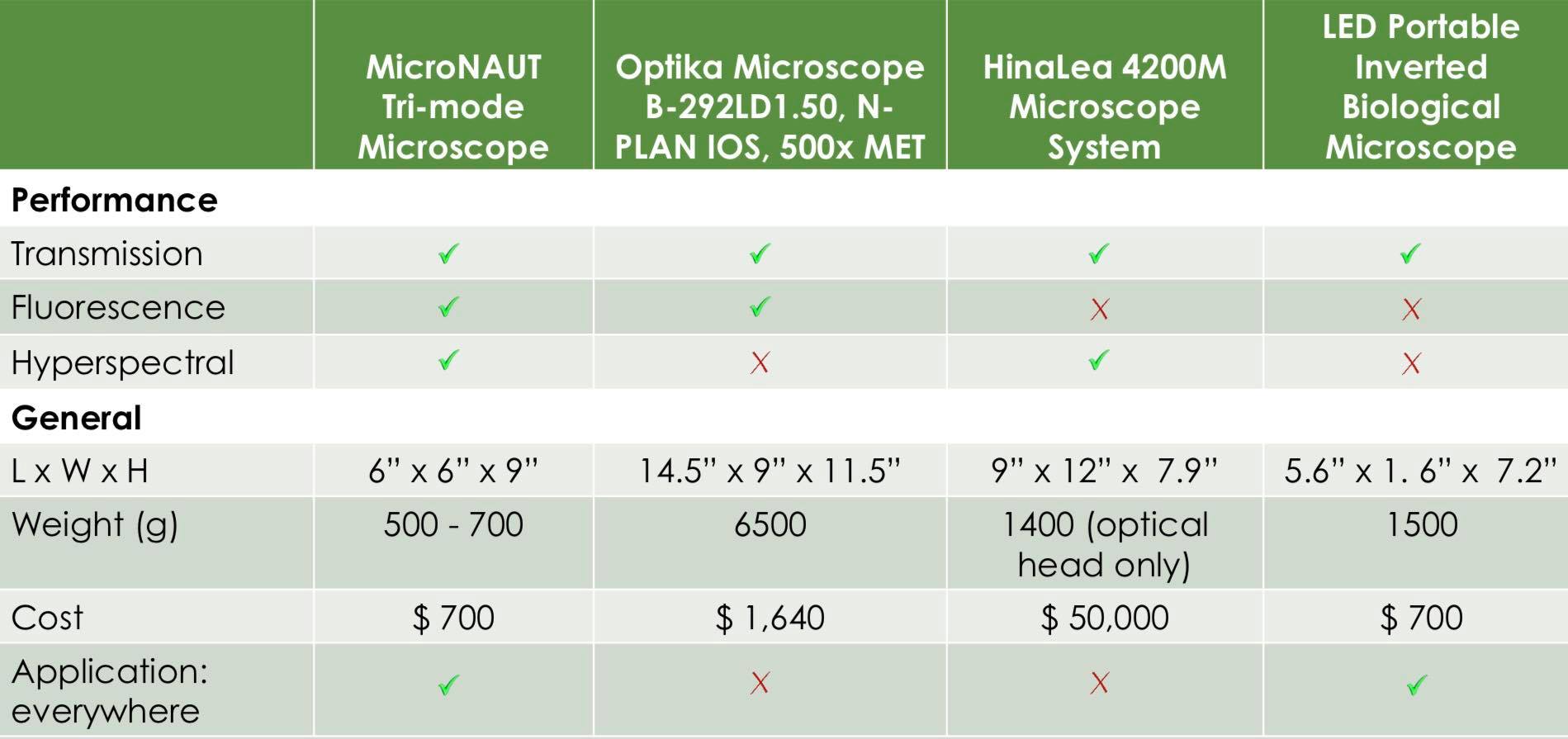
Market strategy: MicroNAUT would apply Pull Marketing Strategy and B2C to fit an open-source product
- Target selling price: $150 - $350 for Transmission mode, $450 for bi-modes: transmission and
Fluorescence
- Github page for software modification and product forum
- Email Opinion Surveys
- Viral tutorial videos of product uses for kids
- Viral videos of customization to expand customer segments
Meet our team
Our team consists of five students pursing biomedical and material
science engineering degrees at the University of California, Irvine.

Michelle Digman
Falculty Mentor

Francesco Palomba
Post-doc Lead

Gisela Lin
CADIM Mentor

Anh Duong
MSE

Eng Lim
BME

Bao Phan
BME

Anh Nguyen
BME

Frank Liu
BME
Contact Us
Please leave a message below if you have any general questions or requests about our products